 |
 |
Download pdf file |  |
Newsletter archives | |
 |
||||
 |
Dieser Newsletter auf Deutsch |  |
Cette newsletter en français | |
|
||||
1. Revision of the EWC Directive: first draft |
 |
|
Legal position of European Works Councils to be significantly strengthened
The report addresses a number of issues already identified in a study by the European Commission in May 2018 (see report in EWC News 2/2018). Key demands of the European Trade Union Confederation presented in March 2017 are also taken into account (see report in EWC News 1/2017). Radtke proposes the following amendments to the directive:
Forthcoming event
The contents of the draft legislation will be discussed in detail at the two EWC seminars in autumn 2022.
|
|
 On 12 May 2022, German MEP Dennis Radtke published the first draft of his report on the revision of the EWC Directive. The Christian Democrat from Bochum and former trade union secretary of IG BCE had been nominated as rapporteur for the report across all political groups. The report builds on a resolution from December 2021 under the title "Democracy at Work" in which the European Parliament called not only for the revision of the EWC Directive, but also for a framework directive on information, consultation and employee participation as well as a strengthening of co-determination in supervisory boards (see
2. Dublin receives official warning from Brussels |
|
|
The Irish Conservative-Green government now coming under close scrutiny
The infringement proceedings stem from a complaint by the Irish trade union SIPTU against the building materials manufacturer Kingspan, which has refused for years to take steps to establish an EWC. The company has expanded in recent years through acquisitions, e.g., takeover of seven factories from the ThyssenKrupp Construction Group. Following a complaint to the Irish government which was unsuccessful, SIPTU turned to the European Commission, criticising the insufficient access to legal recourse and the low sanctions a company faces for breaking the law (see report in EWC News 1/2021).
The explosive nature of the case is also linked to Brexit, which has caused British and US companies to relocate their EWCs from the UK to Ireland on a massive scale. As a result, this has moved the country from 13th to third place in the EU, after Germany and France. The question of appropriate sanctions, which is also the subject of the case, has never been answered legally and could open a "Pandora's box" for the whole legal field of EWCs and SEs (see report in EWC News 4/2021).
SIPTU trade union press release European Commission press release (see under point 10) The process of infringement proceedings
Forthcoming event
The legal situation for European Works Councils under Irish law will be presented at our conference in Dublin from 19 to 21 October 2022.
Parliament debates EWC legislation
Representatives of employers and trade unions were invited to the committee hearing, who unanimously reported that the legal process was inadequate and called for more accessible solutions for resolving disputes. The proceedings before the WRC were adjourned until 22 September 2022. First of all, it has to be clarified whether the WRC is competent to deal with such EWC claims at all. If it does not have jurisdiction, the legal action would immediately go before the Irish Labour Court. The plaintiff is the EWC of the US telecommunications company Verizon, which operates on the basis of the subsidiary requirements and is advised by the EWC Academy (see report in EWC News 2/2021).
Video of the committee meeting in Parliament Discussion in the Senate (Upper House) on 29 June 2022 (see page 666) |
|
 On 19 May 2022, official infringement proceedings were opened against the Republic of Ireland. The European Commission has requested that the government submit a response within two months, since the European Works Council Directive has apparently not been transposed into national law in conformity with EU law. If this were to be confirmed, the Irish EWC Act (TICEA) would have to be amended immediately. Otherwise, the European Commission could refer the matter to the European Court of Justice for sanctions to be imposed on Ireland. This is the first legal case of its kind on the EWC Directive ever brought against a country.
 22 June 2022 was a historic day for EWC law in Ireland. In Parliament (photo), the Joint Committee on Enterprise, Trade and Employment discussed the issue "Engagement on the issue of European Works Councils and related Irish legislation" and the first instance in labour law, the Workplace Relations Commission (WRC), held a hearing for the first time in history on a complaint filed by a European Works Council.
3. Recent Developments at European level |
|
|
Wage Transparency Directive clears another hurdle
Companies are to disclose information that enables employees to compare salaries and uncover a possible gender pay gap. The tools for assessing and comparing salary levels should be based on gender-neutral criteria. If pay reports show a pay gap of at least 2.5% (as opposed to the 5% proposed by the Commission), employers must carry out a pay assessment together with the works council and develop an action plan for equality. MEPs propose to ban confidentiality clauses that would prohibit workers from disclosing information about their pay or requesting information about the pay of others. In addition, the burden of proof should be reversed: the employer should have to prove that no discrimination has taken place.
European Parliament press release
Agreement on minimum wage directive
Minimum wages are to be fixed at 60% of the median wage or 50% of the average wage in a given country and are to be reviewed every two years, either by the legislator or by the collective bargaining parties of the respective country. However, the directive does not only prescribe minimum wages, but also aims to strengthen collective bargaining in general. All member states where less than 80% of the working population is covered by collective agreements must draw up national action plans to increase collective bargaining coverage (see report in EWC News 4/2021). While trade unions in most EU countries have been demanding this for a long time, the Scandinavian countries have expressed reservations. The Swedish trade union confederation LO stopped paying union dues to the European Trade Union Confederation in protest against the minimum wage directive (see report in EWC News 1/2022). However, the LO Executive Board has since announced that it will end the blockade and pay the dues in arrears.
Report on the Strasbourg agreement Communication from the European Council with numerous links
Agreement on telework in preparation
Press release on the work programme |
|
 On 5 April 2022, with 403 votes in favour, 166 against and 58 abstentions, the European Parliament voted to enter into negotiations with the governments of the EU countries on a proposal for a directive to increase wage transparency, which the European Commission had presented in March 2021 (see
  On 7 June 2022, representatives of the Parliament, the Commission and the Member States agreed on the contents of a directive on adequate minimum wages in the EU after an all-night meeting in Strasbourg. Preparatory consultations had already begun in January 2020 (see
  On 28 June 2022, the European social partners (three employers' organisations and the European Trade Union Confederation) signed a historic declaration of intent: they commit to negotiate a legally binding EU agreement on "telework and the right to disconnect". The signing took place during the presentation of the 2022-2024 work programme in the presence of the European Commission. Such agreements emanating from the European Social Dialogue can be implemented as an EU directive if there is a joint request to do so from both social partners. This is an alternative legislative procedure. The planned EU agreement builds on the framework agreement on digitalisation concluded by the social partners in June 2020 (see
 4. Individual Country Reports |
|
|
Historic strike in Finland prevents escape from collective bargaining
In October 2020, the Finnish Forest Industries Federation had declared that it would no longer conclude any new sectoral collective agreements. All existing agreements were to be replaced by company-level agreements before the beginning of 2022. Whereas other paper groups complied, UPM management refused to do so (see report in EWC News 2/2021). The dispute was resolved by both parties accepting the proposal of the national arbitrator. It provides for five separate collective agreements, one for each division of the company, with a duration of four years and a renegotiation of wages after two years according to standard industry conditions. UPM therefore did not succeed to raise working hours without an increase in wages nor to completely escape collective bargaining. Nevertheless, 500 employees have been reclassified as senior managers, so that they will not benefit from future collective agreements. They only retain the rights from the grandfathering provisions of previous collective agreements.
The letter to the shareholders Report on the arbitration result
In the technology sector with companies such as Nokia, Fujitsu or Microsoft, the era of sectoral collective agreements was due to be brought to an end. The employers' association had announced this in March 2021. Nevertheless, a collective agreement was concluded at the last minute on 13 January 2022, because several days of strike action had been announced for the following day.
Report on the new collective agreement
Spanish Industry trade unions replace missing works councils
But who is to be the employer's negotiating partner if there is neither a works council nor a trade union in the company? The employers' associations were seeking to have an ad hoc committee elected at the workplace, while the government gave the negotiating mandate to the representative trade unions (i.e., to those with collective bargaining capacity in the sector concerned). The collective bargaining capacity of trade unions is not determined by membership figures but, depending on the sector and region, by the results of works council elections, which in Spain are as a consequence referred to as "trade union elections".
The Supreme Court upheld the government's position because an ad hoc committee is not able to replace a collective bargaining party. Although, the ruling was formally about gender equality agreements, the underlying key issue reaches far beyond. Legally speaking equal opportunity action plans are in-house collective agreements. As a result of this ruling, trade unions are now able to negotiate company agreements which are valid for all workers without having a single member within the company. The employers' associations also argued on the grounds of data protection, since personnel data for negotiating Equal Opportunity agreements should not be passed on to external trade unions.
CC.OO. trade union press release The Spanish system of workplace employee representation
Framework collective agreement for banks in Romania renewed
The minimum wage for employees in the financial sector has been raised from 2,500 lei (€505) to 3,300 lei (€667). For every five years of service, there is an automatic pay rise, which has also been increased. The holiday entitlement of 21 days plus three days off for family events remains unchanged. The agreement on telework includes reimbursement of equipment and miscellaneous costs, sets limits on surveillance and grants the right to disconnect.
Report on the new collective agreements Current Trade Union Monitor Romania |
|
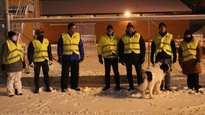 On 23 April 2022, 3,000 Finnish workers from UPM, Europe's largest paper group, went back to work for the first time - after 112 days of strike action. Since 1 January 2022, they had brought all of UPM's production facilities in Finland to a standstill, resulting in a loss of €200 million to the company. The company was unable to meet delivery commitments, threatening a paper shortage throughout Europe. The European Printing Industry Federation therefore urged UPM to put an end to the strike. On 25 March 2022, international trade union federations wrote an open letter to the twenty largest shareholders warning of an investment risk. In solidarity with the strikers, EWC members also refused to cooperate with central management.
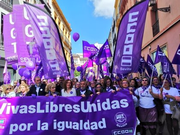 On 28 March 2022, the Supreme Court in Madrid ruled on the question of who is allowed to negotiate equal opportunity agreements in companies where there is neither a works council nor a trade union. The Spanish Confederation of Business Organisations (CEOE) had taken legal action against the government in order to invalidate parts of a legislative regulation. Since March 2019, companies with 50 or more employees are obliged to draw up an action plan for gender equality and the prevention of sexual harassment in the workplace. The works council or - if present - the central works council are to conduct the negotiation.
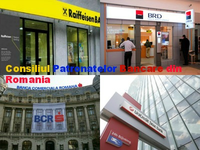 A new framework collective agreement and a telework agreement for the Romanian financial and banking sector were signed in Bucharest on 8 April 2022. They both apply to about half of the 50,000 workers in the sector, covering five major foreign-owned banks: Banca Comercială Română, Raiffeisen Bank (both Austrian), BRD - Groupe Société Générale, ING and UniCredit. Romanian-owned banks such as Banca Transilvania are not included. It is the only sectoral collective agreement in the entire Romanian private sector. When it was concluded in 2018, it was considered a milestone in a country where collective bargaining coverage has declined from 98% to 15% since 2010 (see
 5. Newly established European works councils |
|
|
Austrian mechanical engineering company establishes EWC in record time
The crane manufacturer has 12,000 employees worldwide and is majority family-owned. The EWC has 23 delegates from 17 countries, including four from Austria and two each from Bulgaria, Germany and Slovenia. They meet once a year, usually at Group headquarters. The select committee is composed of five members who meet every two months, three times face-to-face. An extended select committee made up of nine delegates meets twice a year. Extraordinary meetings of the whole EWC shall be held if 25% of its members or at least three countries request it. A full-time position shall be created in the EWC secretariat for the administrative tasks. In the event of disputes, an parity conciliation body with three conciliators each and a neutral chairperson agreed by both sides is to be established. On 21 June 2022, the inaugural meeting was held by videoconference and the first ordinary meeting is scheduled for September 2022 in Bergheim.
Online U.S. retailer with EWC agreement under Irish law
Amazon has 1.6 million employees worldwide, 200,000 of them in Europe. As a result, only countries with 1,000 or more employees are represented on the EWC. There is a three-day plenary meeting each year, with a second meeting at the request of employee representatives. The EWC is competent when 5% of the European workforce or 7% in each of two countries are affected by a measure. In exceptional circumstances, the seven members of the Select Committee and delegates from the affected countries are convened for an extraordinary meeting. If 20% of the European workforce is affected, a plenary meeting is held. The EWC must render its opinion within five days of the meeting.
The Select Committee normally meets twice a year with central management in a video conference. All 35 EWC members have 24 hours' time-off work per year in addition to normal meetings, the Select Committee members 72 hours, and they are entitled to 15 days consultancy per year from an expert of their choice. There is a training entitlement of five days per term of office. In the event of disputes, a conciliation procedure takes place first before going to court. For this purpose, each party appoints one conciliator, plus a third, on whom both parties must agree.
Ambivalent attitude towards collective bargaining
Amazon refuses to conclude collective agreements. The ver.di trade union writes: "The propagated team ideology contrasts with authoritarian management methods and permanent surveillance. The high proportion of temporary workers makes it difficult to organise. Amazon can be considered a prime example of a company with a 'split workforce'." Although there is now a works council at many German sites, there has still been no collective agreement for almost ten years despite various strikes (see report in EWC News 3/2014). In May 2018, the first-ever collective agreement in Europe was successfully enforced at the Castel San Giovanni logistics centre in northern Italy (see report in EWC News 3/2018). The negotiations to establish a European Works Council were chaired by the CGIL company trade union representative from this Amazon site. As recently as September 2020, Amazon was advertising for anti-union experts in the USA via job postings (see report in EWC News 3/2020). In July 2021, an investigation into digital workplace surveillance at Amazon was published (see report in EWC News 4/2021).
Company analysis by the trade union ver.di Trade union press release on EWC establishment Empirical study on the "Amazon Principles" |
|
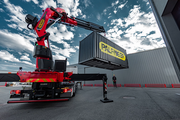 After only three days of negotiations, an EWC agreement was concluded for Palfinger on 5 May 2022. The application to establish a European Works Council had already been submitted in January 2020, but no meetings were held due to the Corona pandemic. The Special Negotiating Body met only once at the group headquarters in Bergheim (near Salzburg). The example demonstrates that in practice, a three-year negotiation period, as required by the EU Directive, is not necessary.
 An EWC agreement for Amazon was signed in Dublin on 11 May 2022. While the Special Negotiating Body operated under Luxembourg law, the Irish branch (photo) now takes on the role of central management. The EWC is a forum made up of management and employee representatives covering only transport and logistics in the online retail sector. The other divisions, such as cloud computing, digital streaming and artificial intelligence, have no delegates nor are they consulted. Despite Brexit, the UK is fully integrated into the EWC.
6. SE works councils and board-level co-determination |
|
|
German transport company establishes worldwide SE works council
The SE works council, which is called the "Flix Team Board", has a three-year term of office. It is composed of 19 representatives from all parts of the world, including one representative for the managerial staff. France and Italy each have their own mandate, all other countries are assigned to regions. Germany, Austria and Switzerland together have three representatives and eight seats are reserved for regions outside Europe. Each delegate can travel once a year to other sites in their region, and there is a right of access to all sites worldwide. There are two annual plenary meetings, one of which is a video conference. The SE works council can establish committees, e.g., on equal opportunities, social and environmental issues, further education or employee mobility between Flix locations.
The SE works council is led by a steering committee made up of four members, which always includes the representative of the managerial staff. It is also responsible for information and consultation in exceptional circumstances, provided that at least 15% of the country's workforce is affected in two countries. The SE agreement contains a precise timetable for the information and consultation procedure; the SE works council's opinion must be rendered within one week. Once a year, the company's group management conducts a survey of the entire workforce. In the future, this will include a section concerning the SE works council on employee awareness and satisfaction.
Escape from Co-determination
The SE agreement permanently excludes the workforce from any membership on the supervisory board. However, the SE works council steering committee is informed by the board of Directors about the content and topics of the agenda within two weeks after each supervisory board meeting. This model resembles the French IT group Atos (see report in EWC News 1/2022).
Press release on SE conversion
Dutch online supermarket accepts supervisory board codetermination
On 12 May 2022, the German subsidiary of Picnic, based in Düsseldorf, announced that its nearly 2,000 employees will in future be represented by two out of six seats on its supervisory board. The delivery service, founded in the Netherlands in 2015, is expanding but currently only has locations in North Rhine-Westphalia and France. There are no plans for a conversion to a European Company (SE) or any other legal form, as was the case for Lidl, Kaufland and Norma, for example. The parent company is subject to different laws in the Netherlands and could easily avoid co-determination in Germany (see report in EWC News 4/2013).
By applying German co-determination rules, the start-up clearly distinguishes itself from its competitors in the industry. As recently as February 2022, the delivery service Gorillas transferred its German warehouses to a Dutch holding company. Flink and Flaschenpost managed to escape co-determination through an SE conversion (see report in EWC News 1/2019). The "before-and-after" principle applies here: co-determination is frozen at the level when the SE is founded. For this reason, many companies convert to an SE shortly before reaching the threshold of 500 or 2,000 employees (see report in EWC News 2/2020).
SE Works Council to be dissolved
Although the workforce has been reduced to a mere 300, two out of the six supervisory board members were still being elected by the SE works council. With the dissolution of the bank, the supervisory board and the SE works council will now cease to exist. As DZ Bank has not yet established a European Works Council, there is no longer any European employee representation, similar to the case of the software company CGM (see report in EWC News 4/2020). |
|
 Flix became a European Company (SE) on 6 April 2022. It operates an extensive long-distance bus network throughout Europe with FlixBus and Greyhound Lines in the USA. FlixTrain is Deutsche Bahn's largest competitor in long-distance passenger rail transport. The Special Negotiating Body made up of 22 delegates from 15 countries represented 1,700 workers including 1,200 from Germany. An SE participation agreement had already been signed in Munich on 30 July 2020.
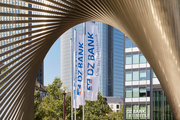 On 5 August 2022, DVB Bank SE, formerly one of the world's most important ship financiers, will be dissolved and integrated into DZ Bank. As the central institution of the cooperative banks, DZ Bank is the second largest bank in Germany. In 2019, DVB Bank had sold important parts of its financial services with more than half of its staff, including its rail, road and aviation businesses. In October 2008, it became the first German bank to adopt the legal form of an SE (see
 7. Explosive legal questions on co-determination in the SE |
|
|
First SE case before the European Court of Justice close to the finishing post
According to the Advocate General, the separate ballot for trade union representatives is a core characteristic of co-determination in Germany and cannot be "negotiated away" by a Special Negotiating Body in the course of the SE conversion. He therefore supports the position of IG Metall and ver.di, which are taking legal action against SAP. Advocates General at the European Court of Justice have the task of elaborating a proposal for judgement ("Opinion") after the oral hearing. They do not represent either party, but are independent and neutral. The court is not bound by these proposals, but in practice it follows the Advocate General's proposals in around three quarters of all cases. The Hans Böckler Foundation is therefore already cautiously optimistic.
Report from the Hans Böckler Foundation Full text of the final opinion
Second SE case on its way to the European Court of Justice
The fundamental questions in the Olympus case also affect many other SE conversions, namely those in which an SE is founded as a company without any employees and later assumes the holding function for subsidiaries with many employees. Does a Special Negotiating Body then have to be established afterwards? If so, does this requirement have a time limit? And if such a negotiating body is subsequently established: is this done according to the law of the country where the headquarters is located or according to the law of the initial SE registration? Olympus had founded the SE without employees in the UK in 2013 and transferred it to Germany in 2017. This also raises therefore the question of the impact of Brexit on the founding of SEs.
Full text of the questions to the European Court of Justice |
|
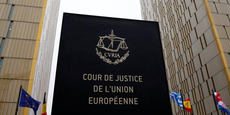 In the legal proceedings for the software group SAP, the Advocate General presented his opinion on 28 April 2022. The issue is whether trade unions can retain a guaranteed share of mandates in a supervisory board with full-parity participation when a German public limited company is converted into a European Company (SE). The oral hearing of the case took place in Luxembourg on 7 February 2022 (see
 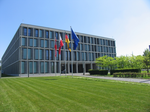 On 17 May 2022, the Federal Labour Court in Erfurt decided once again to refer a fundamental question on co-determination in the European Company (SE) to the European Court of Justice in Luxembourg. The Japanese group Olympus, manufacturer of optical and digital precision technology as well as cameras and microscopes with 7,000 employees in Europe, is being taken to court by its German group works council for evading co-determination (see
 8. Pan-European company agreements |
|
|
French bank signs charter on teleworking
The charter limits teleworking to 50% of working time with at least one day compulsory presence per week. The principle of double volunteering applies (supervisors and teleworkers must both agree) and there is no legal right to telework. The workplace must be suitable for remote work (safety, ergonomics, quietness, secure internet connection, etc.) and it must not be an external location such as a coworking space. The company office must be accessible within half a day in urgent cases. Concerning cross-border telework, a study will first be conducted to assess its impact in terms of health insurance. The agreement obliges the bodies concerned in the 22 countries to negotiate the use of telework with employee representatives. The application of the charter will be monitored by the European Works Council. In October 2020, the Italian bank UniCredit had signed a similar declaration (see report in EWC News 4/2020).
Pan-European job guarantees secured after transfer of business
Even before the decision to sell to Bouygues was taken, Engie's EWC was able to consult all prospective buyers in October 2021 and submit demands for social guarantees (see report in EWC News 4/2021). The protocol provides for a five-year employment guarantee for all 60,000 Equans employees in Europe, 10,000 new jobs within five years, 2,000 apprentices in France alone, training opportunities in all European countries and an employee share ownership plan. The social guarantees will be overseen by a European Divisional works council, which will be established immediately after the closing of the sale and is composed of 18 delegates from Equans and ten from the Bouygues Energy & Services division. In addition, Equans may appoint six delegates to the EWC of the Bouygues holding company, whose EWC agreement was last updated in March 2021 (see report in EWC News 3/2021). |
|
 On 6 April 2022, the major bank BNP Paribas published in Paris a European Charter on Teleworking, which was concluded with the EWC and two trade union organisations at European level in November 2021. It covers 132,000 employees in 22 countries and complements three already existing agreements. In 2012, the European Works Council had concluded a social charter with central management, in 2014 an agreement on gender equality and in 2017 on the prevention of stress at work (see
 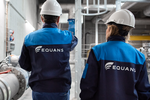 On 13 April 2022, the French construction group Bouygues signed a protocol with the EWC of the French energy group Engie on social obligations in its forthcoming acquisition of Equans, Engie's technical services division. It is the first ever transnational company agreement in the economic history between an EWC and a buyer (Bouygues), without the involvement and liability of the seller (Engie). The protocol was also ratified by three European trade union federations.
9. The view beyond Europe |
|
|
US digital platform company making its first approach to unions
Controversial framework agreement in French care group
Unions in countries such as Chile, Colombia and Poland are given enhanced rights to talk to staff, train managers against anti-union behaviour and to hold the company to account. Unions from Western Europe, on the other hand, criticise the agreement because they were not involved in its negotiation and are currently in a massive dispute with Orpea. Apparently, there had been no prior discussions between the international and European trade union federations.
On 8 March 2022, a protest action by French, Belgian and German trade unions took place at Orpea's headquarters in Puteaux, west of Paris. The private care company is currently making the headlines as a bad employer, for anti-union behaviour, misuse of public funds and for mistreatment of its patients. On 22 March 2022, the Bremen Labour Court (Germany) awarded the chairwoman of the works council of the Weser Wohnpark senior residence, who is also the EWC chairwoman of Orpea, €15,000 in damages for discrimination and harassment. Furthermore, on 26 March 2022, the French government announced that it would initiate criminal proceedings against Orpea for allegations of mistreatment of elderly patients. In October 2020, negotiations to establish a European Works Council had failed (see report in EWC News 4/2020).
Press release on the signing of the framework agreement Report on the framework agreement Full text of the framework agreement Criticism from the European trade unions UNI's response to this criticism Press report on the compensation for the EWC chairwoman Report on the court case in Bremen
First local union representation at Apple in the USA
Apple management had previously distributed guidelines to office managers to discourage workers from joining a union and hired consultants specialised in preventing the establishment of unions. Unionisation has recently gained momentum in the US. On 1 April 2022, a majority at an Amazon warehouse in New York with 8,300 workers voted in favour of union recognition, the first in the Amazon group in the US. A union was established for Google´s parent company Alphabet in January 2021 (see report in EWC News 1/2021). The Labour Relations Board is a federal agency established in 1935 to protect the right of private sector workers to join a union and organises such ballots upon request.
Report on the results of the ballot Labour Relations Board website Fact sheet on workers' rights in the USA |
|
 On 17 February 2022, a Memorandum of Understanding was signed between the International Transport Workers' Federation (ITF) in London and the management of Uber in San Francisco. The 30,000 drivers and couriers of the passenger transport and meal delivery service worldwide are to be better protected in the future. The declaration includes the right to union representation, freedom of association and collective bargaining, health and safety, social security and dispute resolution. The parties will regularly exchange views on these issues. In February 2021, the UK Supreme Court had ruled that drivers of the digital platform were employees rather than self-employed contractors, prompting Uber to change its business model (see
 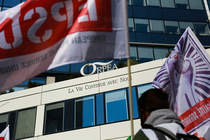 On 8 April 2022, an international framework agreement was signed between the Global Union Federation for the Services Sector (UNI) and the central management of Orpea. It covers 70,000 workers in 23 countries around the world and aims to improve working conditions and the quality of care for residents and patients through enhanced social dialogue and trade union rights. It is the first global agreement that unions in the health and elderly care sector have been able to reach.
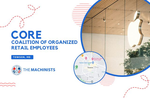 On 18 June 2022, the National Labour Relations Board announced the results of a ballot of the 110 employees at the Apple store in Towson, a small town in Maryland. The employees had established their own union, the Coalition of Organised Retail Employees (CORE), and wanted to conclude an in-house collective agreement. They were supported by the International Association of Machinists and Aerospace Workers (IAM), a metalworkers' union with 600,000 members and affiliated to the international federation industriALL.
10. Interesting websites |
|
|
Research on the transformation of the working world
Information on the LABOR.A conference
Trade unions in financial technology (FinTech) companies
Report on industrial relations in the FinTech sector Report on the final conference of the project
Government information on supply chain legislation
|
|
 On a dedicated website, the Hans Böckler Foundation presents documents from the "Work of the Future" research unit, which was established in 2018. It bundles research on digital and socio-ecological transformation processes and their impact on the world of work. The main question is how such a transformation can be shaped in a fair and humane way. A conference is held once a year, LABOR.A.
 Observatory on co-determination in the digital economy
 On 10 May 2022, a final conference was held in Copenhagen to conclude an EU-funded research project examining the impact of FinTech companies on the financial industry and the role trade unions can play in securing good employment in the sector. The two-year project was a joint initiative of the European umbrella organisation of service unions (UNI Europa), the Scandinavian financial unions and the University of Gothenburg. The research focused on Sweden, Estonia, Denmark and the Netherlands. The demonstration of how difficult it can be to set up a works council in a FinTech company was made by Direktbank N26 in Berlin in August 2020 (see
  On a dedicated website, the German government presents its activities on human rights due diligence. This includes a national action plan to prepare large companies for the new Supply Chain Act, which comes into force in January 2023 (see
 11. New publications |
|
|
Trade union responses to the Digital Transformation
Further information and download
Facts and figures on employment of the future
Brief description of the publication
Challenges of digitalisation in the retail sector
Download other language versions
Better rules for subcontracting
|
|
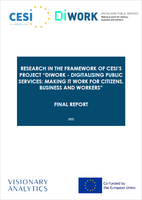 The final report of an EU-funded project on digitalisation, prepared by a Lithuanian consulting firm, was published at the end of April 2022. It examines digitalisation trends, driving forces and obstacles, digital skills, impact on work organisation and possible trade union responses in selected countries and four sectors: public services, education, healthcare and postal services. In this context, risks of deteriorating working conditions and potential impacts on occupational health and safety are also highlighted. It is published by the European Confederation of Independent Trade Unions (CESI), the second largest trade union federation in Brussels after the European Trade Union Confederation (ETUC). Its German affiliate is the Federation of Civil Servants (Beamtenbund), which with 1.3 million members competes with the German Trade Union Confederation (DGB) and its 5.9 million members.
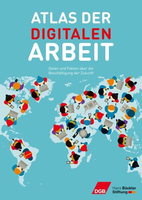 At the beginning of May 2022, an atlas of digital work was published for the first time in Germany, jointly edited by the Hans Böckler Foundation and the German Trade Union Confederation. It shows in many graphics how digitalisation is changing the working world. Individual chapters examine, for example, the automotive and chemical industries, platform work, artificial intelligence or the new possibilities of surveillance in the workplace including the home office. A separate chapter is devoted to the online mail order company Amazon and its surveillance technologies (see
 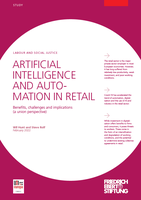 A study carried out by the Friedrich Ebert Foundation and the European Services Workers' Union (UNI) on automation in the retail sector was published in early May 2022. In most European countries, the retail business is the largest employer in the private sector, best known for low productivity, little investment and poor working conditions. The Corona pandemic has greatly accelerated the trend towards automation, digitalisation and the use of artificial intelligence and robotics in the retail sector. The study shows the driving forces behind technological development in the sector: e-commerce and outsourcing, cashless payment systems, monitoring and control systems, autonomous warehouses and robotics, automation in human resources and virtual reality. From these trends, the authors from the University of Sussex elaborate possible trade-union policy responses. The study is available in four languages.
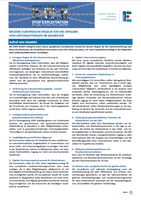 In June 2022, the European Federation of Building and Woodworkers launched a campaign against exploitation in subcontracting chains in the construction industry under the title "Who's the Boss?". A detailed "Call to Action" identifies ten key demands and describes case studies from Belgium, France and Denmark. Large construction companies often generate 50% to 80% of their turnover from subcontracting. There are construction projects that are carried out with 100% of subcontractors. The longer the subcontractor chain, the more difficult it is to monitor and enforce laws and collective agreements. Exploitation thus becomes a business model. The appeal calls for the strengthening of European Works Councils. They should be given all the information they need to analyse a company's procurement policy and identify risk factors. Local employee representatives should have the right to carry out site visits and audits without prior notice.
12. The EWC Academy: examples of our work |
|
|
Continuation of EWC negotiations after long break
The European Works Council was established in 2007 under UK law and its meetings are chaired by the employer. Since Brexit, it is subject to Dutch law. In June 2021, the US group AmerisourceBergen bought almost all the European subsidiaries of Alliance Healthcare (see report in EWC News 3/2021). Following this acquisition, the EWC now represents more than 15,000 workers in eight countries, including 6,500 in the UK. In March 2021 it won a dispute before the Central Arbitration Committee in London (see report in EWC News 1/2021).
EWC training in Japanese electronics company
Annual EWC Conference exceptionally in summer
|
|
 From 9 to 11 May 2022, the first face-to-face meeting of Alliance Healthcare's EWC since the start of the Corona pandemic took place in Windsor. The English residential town to the west of London is close to the European headquarters of the wholesale supplier of pharmaceutical products. Negotiations had started in October 2019 with the support of the EWC Academy (see
  On 8 June 2022, EWC Academy provided training for the European Works Council of Epson at its European headquarters in Amsterdam. The Japanese company manufactures printers and imaging technology. The EWC, formed in 1997, is governed by Dutch law and represents 2,000 employees in 23 countries including the UK. A new EWC agreement was signed the day after the training. It increases the number of delegates from eight to ten and for the first time gives the Scandinavian and Eastern European countries their own seats. The last training had taken place in June 2018 (see
  The 14th Hamburg conference for European and SE works councils, originally planned for January, took place on 27 and 28 June 2022. As in the previous year, it had to be postponed due to the Corona pandemic. The program included the latest developments in the European Parliament and an analysis of the current status of transnational company agreements. Furthermore, the example of Adecco was presented, whose EWC was able to win a lawsuit in March 2021 (see
 13. Current seminar schedule |
|
|
The EWC Academy and its forerunner organization have been holding conferences and seminars for the members of European works councils, SE works councils and Special Negotiating Bodies since January 2009. So far, 855 employee representatives from 295 companies have taken part including many of them for several times. This represents around 25% of all transnational works council bodies in Europe. In addition, there are numerous in-house events and guest lectures given to other organizations.
Overview of the forthcoming seminar dates
Two seminars after the summer break: Data protection and Subcontracting/Outsourcing
EWC and SE Seminar in Kassel
The program of the introductory seminar Report from a previous introductory seminar in Montabaur
First ever EWC conference in Ireland
The programme of the basic and advanced seminars
In-house events
|
|
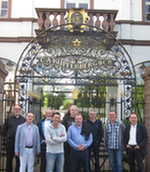 From 31 August to 2 September 2022, two seminars will take place in Mainz: 1. a data protection seminar and 2. a seminar on employment contracts, temporary agency work and subcontracting/outsourcing. The focus of seminar 1 is the EU General Data Protection Regulation. A risk assessment is carried out taking into account the respective company structures, problems of outsourced data processing and the contents of company agreements are on the agenda. Seminar 2 deals with the connection between procurement policy and sub-contracting chains, examples of misuse and control possibilities for works councils. The evening program includes a visit to the Kupferbergterrasse, a medieval vault with the deepest champagne cellar in the world (photo from a previous seminar).
 From 4 to 7 October 2022, our annual seminar for members (including future members) of European Works Councils, SE Works Councils and Special Negotiating Bodies will take place. Several seminar modules will be offered for beginners as well as for advanced participants. The seminar will be exceptionally held at the Castle hotel Bad Wilhelmshöhe. From spring 2023, the seminar will once again be organized as usual at Montabaur Castle.
 In recent years, the EWC Academy has held six conferences for European Works Councils in London. After Brexit we are moving them to Dublin, as many UK and US companies have done with their EWC (see
 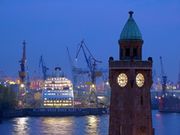 Legal EWC seminar in Hamburg
14. Imprint |
|
|
EWC News is published by:
|
|