 |
 Welcome to issue no. 3 / 2007 of EWC News. 31 October 2007
|

|
The
training and consultancy network
"euro-workscouncil.net"
EWC
News appears four times a year.
You can find past issues in the newsletter archives.
|


|
1.
European Commission gives green light
|
|
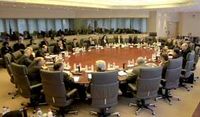
On 23rd October 2007 the European Commission in Brussels (photo) adopted its work programme for the year 2008. There, a revision of the EWC Directive is explicitly mentioned. The second phase of the European social partners consultation is expected to start before the end of the year 2007 what is demanded by the trade unions for over two years. The decision of the European Commission is a political precedent of the first rank and corresponds to the demand of the European Parliament which had voiced in favor of the speedy revision of the EWC Directive in a resolution in May 2007 (see report in EWC News 2/2007). Social Commissioner Vladimír Špidla has already instructed his staff to formulate a draft legal text. Should the Czech social democrat wants to make a name for himself as EU Commissioner on this important socio-political issue before the expiry of his term of office (what his remarks in the plenary of the European Parliament suggests) then not much time left for the final stages of the legislation process. What content will the initiative have?
To suggest an improvement over the current EWC Directive, the document of the Directorate-General of Špidla will most likely
Such a suggestion from the European Commission would not only take up important demands of the trade unions but also calm French enterprises, which are made uncertain by numerous judgements. Almost all proceedings since adoption of the EWC Directive were decided in front of French courts and brought as a rule an increase in influence for the employees' side. In 1997 a French court had for the first time stopped the shutdown of the Belgian plant Vilvoorde on application of the Renault EWC. The more recent verdicts on Gaz de France and Alcatel-Lucent (see report in EWC News 2/2007) also point in the same direction.
This trend is now seen not only for French companies as a threat (see report in EWC News 1/2007) and a more precise definition of the legal rights of the EWC is specifically requested. In addition, EU Directives of a recent date like that for the participation in the European company (SE) provide further-reaching participation rights than the relatively old EWC Directive. This could pose an additional risk for employers in court.
Employers now very concerned
After the Confederation of European Employers (BusinessEurope) in a meeting on 19th October 2007 again underscored his opposition to any change to the current Directive, the European Trade Union Confederation (ETUC) on 29th October 2007 demanded in a letter to Špidla, he should carry out the announced project as planned. According to reports the European Commission has already prepared a roadmap that describes the various steps to the adoption of the new Directive, if the employers' associations maintain its opposition. |
 A new EWC Directive shall be
adopted in 2008
A new EWC Directive shall be
adopted in 2008 
|
2.
Mega-mergers complicate the EWC work
|
|
Hilton hotels acquired by financial investor
European works council in the spectator role
When
the German delegates met
in February 2007 to prepare for the spring meeting of the EWC, nobody
suspected the upcoming events. The sale of the 132 Scandic hotels to
the Swedish financial investor EQT for 1.1 bn $ (0.8 bn €) had
just been published. Hereafter on the part of the management there was
a strange silence, until finally, on 3rd July 2007, the takeover offer
by Blackstone followed.
Rio Tinto denied information
Mega-acquisition in the financial sector
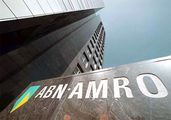
The federation of services sector trade unions (UNI) founded in June 2007 a worldwide network which quickly led discussions with the top management of the two bidders to clarify the demands of the employees. The result is a ten-point commitment by the new owners, so-called "People Principles". The unions want to go much further and call for an international framework agreement for each of the participating banks, including Barclays. All have a European works council since the mid-90s, only Banco Santander was followed in 2005. As part of the acquisition, the EWC of ABN Amro will be dissolved and delegates distributed to other councils. ABN Amro has a subsidiary in Sweden, which was transformed in October 2005 as Europe's first bank to the legal status of a European Company (SE). |


|
3. No
fear of the courts
|
|
Second round of merger poker with the EWC
On 2nd September 2007, the employee representatives of Suez were informed on the details at an extraordinary meeting in Paris. On 4th and 5th September 2007 the steering committee of the EWC met to decide his next moves. The merger would create the third largest energy group in the world, beforehand the waste and water business should be removed from the Suez group and sold on the stock exchange. At a plenary meeting on 9th and 10th October 2007 in Barcelona, the European works council of Suez authorized its secretary, that is the speaker of the employees' side, to initiate legal steps. In a press statement, he criticized the fact that the details of the merger have been negotiated between the French government and the main shareholders of both companies, without first obtaining the views of the works councils. This was a breach of the EWC Directive. EWC of Gaz de France is playing for time
At an extraordinary EWC meeting on 12th September 2007 the European works council of Gaz de France expressed his opposition. It would be a new measure that differs from the plans of 2006 in many ways. Therefore, a completely new process of information and consultation would be required. In another EWC meeting on 26th October 2007 the various legal opinions clashed already.
The EWC members had received a more than 100-page document for consultation only a few days before. They refused to comment on this until all have a copy available in their mother tongue. The EWC warned the central management to unilaterally implement measures before the completion of the consultation process. This would immediately lead to a new round of litigation. Hence the central management will have to act cautiously to avoid a new defeat in court. This would not only delay the merger process, but also damage the new French president politically.
European trade unions set up legal protection fund
Success for workers' representatives in Vienna
On 31st January 2007 the Supreme Court of Austria ruled in favor of the obligation to provide information in preparing the establishment of an EWC, confirming a ruling of first instance of 11th January 2006. It is the first ever ruling by an Austrian court in an EWC matter. Since 1996 the German group works council of the transport company Kühne + Nagel (KN) failed to establish an EWC. Several times he had already to sue in court translation and travel expenses. The KN group based in Switzerland and therefore outside the EU wants to prevent by all means the creation of a pan-European employee representation.
The dispute goes back to a decision of the European Court of Justice in Luxembourg in January 2004 that the German subsidiary of the group has to initiate the necessary steps for the formation of the EWC. However it is not authorized to issue instructions to its sister companies based in other EU countries. Since the central management in Switzerland continued to boycott the procedure, legal steps had to be taken again. Kühne + Nagel Hamburg went to court against Kühne + Nagel Vienna, because the Austrian management refused to give information to Germany. So the employer sued himself to delay the EWC foundation further. A similar lawsuit is currently pending in Sweden.
|
 In view of the increasing number of legal
disputes in EWC issues the European Federation of Public Service Unions
(EPSU) will establish a legal protection fund. Deputy General Secretary
Jan Willem Goudriaan told the EWC News, EPSU is thus playing a
pioneering role. No other federation has such a fund so far.
In view of the increasing number of legal
disputes in EWC issues the European Federation of Public Service Unions
(EPSU) will establish a legal protection fund. Deputy General Secretary
Jan Willem Goudriaan told the EWC News, EPSU is thus playing a
pioneering role. No other federation has such a fund so far.
|
4.
New EWC and SE agreements
|
|
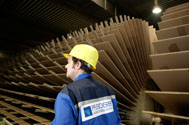
An EWC agreement was signed for the employees of Pfleiderer under German legislation on 9th August 2007. The company from Neumarkt (Bavaria) has eight locations in Germany and three in Poland, furthermore a company in Sweden was incorporated in March 2007. Pfleiderer supplies the furniture industry with wood materials such as chipboards.
Germany will get four seats on the EWC, Poland two and Sweden one. Eight EWC meetings will take place during the first four years, at least one per year. The council is headed by a steering committee composed of three members. The constituent meeting is scheduled for November 2007.
For the first time on 30th August 2007, an EWC agreement for Bilfinger Berger Industrial Services (BIS) was signed in Munich. The company, emerged from Rheinhold & Mahla, belongs to the Bilfinger Berger group since 2002 and deals with the establishment and maintenance of industrial plants. In addition to 22 German locations there are branch offices in 15 EU countries and Switzerland. At the constitutive EWC meeting, held on the same day, there was a crucial vote for the chairmanship.
In the assembly company Kaefer there has been a European works council already since 1995 which now has a new foundation. On 11th September 2007 the new EWC agreement was signed at the headquarters in Bremen, which both includes the new EU countries and defines the participation rights of the EWC more clearly. The next aim of the EWC is to negotiate with management for minimum conditions for the cross-border posting of employees.
On 6th September 2007 an EWC agreement was signed under German law for PFW Aerospace in Speyer (formerly Palatinate aircraft works). Germany is represented with five seats, France and the UK each with two. The EWC meets twice a year, can establish its own working groups such as occupational health and safety and has an access right to all European plants. Special meetings will be held for unforeseen events. In the case of mergers, a renegotiation of the entire EWC agreement is provided, whereby the new EWC Directive is already pre-empted.
On 12th September 2007 Europe's first agreement that includes Macedonia was signed for the about 10,000 employees of the regional energy supplier EVN establised in Maria Enzersdorf (Lower Austria). In addition to three representatives each from Austria and Bulgaria one representative from the former Yugoslav republic will belong to the EWC.
We have made available other EWC agreements on a separate download page. Saarland electrical manufacturer with SE works council
Since 1998 Hager has a 17-member European works council which could meet once a year. This is now replaced by an SE works council which meets twice a year and has stronger participation rights than the EWC. Its 22 members, including six from France and three from Germany, came together for the constitutive meeting on 18th September 2007 in Obernai (France). Since Hager has less than 2,000 employees in Germany, the company did not fall under the Co-Determination Act. Therefore there will be no employee representative on the new SE supervisory board. |


|
5. Worldwide
social standards
|
|
In recent months two new framework agreements were signed on the application of social principles and core labor standards in global companies. Contracting parties on the employee side are the international trade union federations.
On 28th September 2007 an international framework agreement was signed in Brussels for 14,000 employees of the Belgian metal and chemical company Umicore which covers 35 countries. In the agreement human and trade union rights, working conditions, environmental issues and equal treatment are addressed. A committee will monitor compliance with the agreement. On 4th October 2007 the first international framework agreement in the textile industry was signed in Corruna (Spain) for the world's second largest clothing retailer Inditex. It provides for the respect for international labour standards throughout the production chain, thus also for the suppliers. The agreement will be monitored annually by a working group made up of three representatives of the company and the unions. The management of Inditex tries already some time to ensure compliance with minimum standards (see report in EWC News 1/2007).
Success in Brazil
In May 2007, the Canadian printing group Quebecor had signed a global framework agreement (see report in EWC News 2/2007), which now shows initial success. Following a worldwide day of action a social dialog was installed at the factory Ipojuca (Brazil), the local union recognized as a negotiating partner, 80 temporary workers fixed and the dismissal of workers representatives reversed.
After the successful conclusion of negotiations on a European works council for the steel group (see report in EWC News 2/2007), 150 workers representatives from 23 countries met for the first ArcelorMittal World Conference from 16th to 18th September 2007 in Montreal (Canada). They signed an agreement on international cooperation and a letter of intent to form a global works council. Global conference of Siemens works councils
|

 ArcelorMittal
on the way to the global works council
ArcelorMittal
on the way to the global works council
|
6. Case
studies: Unilever and Volkswagen
|
|
Staff cuts despite record profit
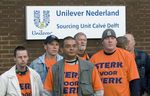
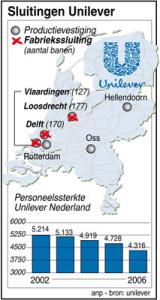
The European works council learned of it from the press and addressed on the same day in a circular to all employees. But only on 4th September 2007 it met with central management in Rotterdam at an extraordinary meeting, which however did not provide any concrete information on the proposed measures. On 24th and 25th September 2007 the European works council and the European Federation of Food Trade Unions (EFFAT) founded Unilever Coordination Committee came together in Amsterdam with representatives from Germany, France, Britain, Italy and the Netherlands to plan the protests across Europe. Highlight should be a demonstration on 4th December 2007 at the corporate headquarters in Rotterdam. Solely in the Netherlands three out of six plants are to be closed (see graphic). There, the workforce went on strike on 11th October 2007 to maintain all sites and to enforce a three-year job guarantee. From an external consulting firm which was engaged by the works councils the viability of all locations had been confirmed earlier. Since the national managers only execute the decisions of the European headquarters they are no real negotiating partners for the employee representation. The European works council on the other hand has only consultation, but no bargaining rights. The union FNV Bondgenoten documented the events on its own web page. Also in France 4,000 jobs should be eliminated - in ten plants and in the central administration. On 18th October 2007 the employees' side in the group works council discussed about that.
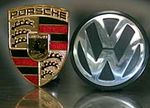
Judges weaken Volkswagen participation Thus, the way is free for Porsche for a takeover of the majority stake in Volkswagen. For this reason Porsche Automobil Holding was founded as a European company (SE) already in July 2007 (see report in EWC News 2/2007). Under the umbrella of the holding company the current Porsche AG (100% subsidiary) and the 31% stake in Volkswagen are summarized. The employee representatives of Volkswagen were not involved in negotiating the participation agreement which is terminable at the earliest in ten years.
EWC fears dissolution
As soon as Porsche increases its VW stake to more than 50%, the most important decisions would no longer be made in the supervisory board of Volkswagens but in the supervisory board of the new Porsche Automobil Holding SE. Employees of both sub-groups are to be represented properly there - says the SE agreement. In practice 324,000 Volkswagen employees would only get three seats, as much as the nearly 12,000 Porsche employees. The European works council at VW, which consists of 27 members, would be dissolved and Volkswagen be represented with twenty delegates in the SE works council of Porsche. Likewise Porsche is to receive twenty seats there. On this point there was a public dispute between the two works council chairmen. On 10th October 2007 the global works council of Volkswagens also supported the criticism at its meeting in Mladá Boleslav, seat of the Czech subsidiary Škoda. Currently it is still unclear whether this council, which enforced a world-wide Social Charter in June 2002, will also be dissolved. Since the management of Porsche strictly rejects renegotiations the works council of Volkswagen requested an interim injunction against the registration of Porsche Automobil Holding SE. On 24th October 2007 the Stuttgart labour court rejected this request. This cleared the way for the register court to finalize the registration on 13th November 2007. The works council of Volkswagen has announced to proceed then with the normal judicial action. Porsche is now the second case in which there is such a litigation. Already 2004 the registration of the construction holding Strabag SE led to a legal dispute that could be settled by mutual agreement but without verdict. The following texts are only available in German: Intervention of IG Metall executive board
Dr. Thomas Klebe, head of department for company policy and codetermination in the head office of IG Metall trade union, considered not undermined by the judgment the participation in the supervisory board of Porsche Automobil Holding SE. To solve the conflicts between the two works councils, a conversation took place on 30th October 2007 in Frankfurt am Main at the invitation of the second chairman of IG Metall, Berthold Huber. Earlier the Porsche works council signaled willingness to compromise regarding the allocation of seats in the new SE works council.
In protest against the unfavorable codetermination scheme the work rested for an hour in all six West German VW plants on 31st October 2007. Strikes are not possible in Germany due to the peace obligation. However the Works Constitution Act gives works councils the right to such information sessions during working hours.
|
|
Interim evaluation at General Motors
The employees of IBM in Italy have developed a new form of action. With a virtual strike on the popular Internet platform "Second Life" they protested against the cancellation of an annual profit sharing of 1,000 € and thus strengthened the bargaining position of the Rappresentanza Sindacale Unitaria (RSU = Italian works council).
Spanish banking group promotes gender equality
On 8th October 2007 a landmark agreement on gender equality was signed in Madrid for the global financial services provider Banco Santander. It is based on the equality and anti-discrimination law, which came into force in Spain on 24th March 2007 and requires all companies of 250 employees to do so. A similar agreement was concluded in December 2006 for the French company Areva.
|
 On
4th and 5th July 2007 the final conference of the GMEECO project
("Requirements and Perspectives of the General Motors
Europe Employees Cooperation")
was held in Frankfurt, Germany. With this project started in December
2005 and funded by the EU, a Europe-wide coordinated strategy for the
employee representatives against site competition should be developed.
An important goal, the conclusion of a pan-European framework agreement
on the future distribution of production to countries and sites, was
not achieved in the short duration of the project. Conference conclusions were
drawn from past cooperation and also discussed was the need to revise
the EWC Directive.
On
4th and 5th July 2007 the final conference of the GMEECO project
("Requirements and Perspectives of the General Motors
Europe Employees Cooperation")
was held in Frankfurt, Germany. With this project started in December
2005 and funded by the EU, a Europe-wide coordinated strategy for the
employee representatives against site competition should be developed.
An important goal, the conclusion of a pan-European framework agreement
on the future distribution of production to countries and sites, was
not achieved in the short duration of the project. Conference conclusions were
drawn from past cooperation and also discussed was the need to revise
the EWC Directive. 
|
8. The Anglo-Saxon
system of corporate social relations
|
| Ireland goes other ways than
Britain
About 70% of all foreign investments come from the U.S., including many high-tech companies and financial service providers engaged in a strongly anti-union strategy. However trade union membership is about 35%, higher than in the United Kingdom (28%). The Irish Congress of Trade Unions ICTU include 81 individual trade unions, which are also found in Northern Ireland. The other way around British trade unions as Unite which arose in May 2007 from the merger of Amicus and T & G also recruit members in the Republic of Ireland. Collective bargaining has been continuously encouraged by the Irish State unlike in the UK in Thatcher years. The two sides are working with the government in tripartite bodies such as the Labour Relations Committee, which can intervene in labour disputes. Local works councils introduced by EU legislation in 2006 Many Irish employers oppose the introduction of works councils, which they believe to be a relic from the 60s and 70s. The current pace of industrial change would require a direct communication with employees, and not via the detour of a works council. To meet the requirements of an EU Directive from 2002 which prescribes mandatory in companies from 50 employees information and consultation of the workforce in social and economic issues, the Irish government had to act, however, and to disregard these comments. The Employees (Provision of Information and Consultation) Act 2006 introduced works councils for the first time. At the election, however, only union members may participate whose organisation represents at least 10% of the workforce. An election by the entire workforce will take place only when there is no union with a 10% membership. European works councils in Ireland
Ryanair in a legal dispute over employee representation
A 2004 law gave the unions the right to represent their members also in companies without employee representation, so called "non union companies" such as Ryanair. Nevertheless, the management blocked with regard to the “Employee Representation Committee" (ERC), a replacement employee representation without union connections, founded by Ryanair. On 1st February 2007 the Supreme Court ruled on the collective bargaining competence of the ERC. Indeed the dispute was referred back to the Labour Court due to lack of evidence (from Ryanair staff no one was willing to testify), but the court made it clear that Irish workforce is entitled to an appropriate collective representation. Only in 2006, Ryanair was ordered to pay a fine of 1 million €, because senior managers had made false statements in court.
The recognition of a union plays a central role also in the British system. On 11th October 2007 a landmark agreement was concluded for the regional offices of the mobile phone company Vodafone. For the first time ever in company history, management agreed to recognize a union (in this case, the communication workers' union Connect) and to install an employee representation. The new agreement applies only to approximately 500 of the total 11,600 British employees. The remaining staff must continue to work without collective protection. The move was not voluntary. Only after intervention of the independent Central Arbitration Committee, management was willing to sign the agreement. In a similar case a London industrial tribunal ordered the newspaper publisher Macmillan in July 2007 to pay a fine (see report in EWC News 2/2007).
"Union busters" in the food industry
In the end the consultants from Malibu (California) could nevertheless achieve a success. Much of the workforce - about 40% are immigrants from Eastern Europe - were so intimidated that they voted in a ballot against the union. The British Trades Unions Congress (TUC) has now announced to train trade union officers specifically to hunt the hunters in the future ("to bust the busters"). The ruling Labour Party sees in the behaviour of the plant management a breach of UK employment law. A breach of EU standards should also be given. Previous country focuses in EWC News: (mostly in German)
|
 The
situation is more difficult at the food manufacturer Kettle Chips. In
September 2007 the management hired "union busters" from the USA (they
call themselves more kindly as "Labour relation consultants") to stop
the legal procedure for the establishment of worker representation. The
340 employees at the Norwich plant should be discouraged from joining
the trade union Unite. The conflict arose in the payment of overtime
and led to a media campaign and a consumer boycott against the company.
The
situation is more difficult at the food manufacturer Kettle Chips. In
September 2007 the management hired "union busters" from the USA (they
call themselves more kindly as "Labour relation consultants") to stop
the legal procedure for the establishment of worker representation. The
340 employees at the Norwich plant should be discouraged from joining
the trade union Unite. The conflict arose in the payment of overtime
and led to a media campaign and a consumer boycott against the company.|
9. EWC and authoritarian
corporate culture
|


|
European tourism portal
In many multinational companies unions have established networks to exchange information between workers' representatives around the world, a precursor to the world works council. There has been such a network since 1999 for the U.S. tire manufacturer Goodyear, organized by the International Federation of Chemical Workers' Unions (ICEM). News and comments are provided in different languages on a specially established Blog on the Internet. Once or twice a year the network sends a newsletter titled "Global Solidarity" in English, French, Spanish and German. New website for the European Social Fund
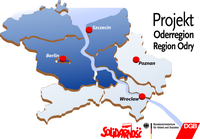
The DGB country district of Berlin-Brandenburg has a website on European policy issues since October 2005, which includes information related to an EU project that aims to bring together the economic region west and east of the river Oder. Together with Polish trade unions, for example, issues of labour market and social policy are discussed. The following documents are only available in German: We have compiled many other interesting links in a collection of links.
|
 On 24th and 25th October 2007
the new Internet portal of the trade unions in the tourism sector was
presented to the public at a conference in Portimão
(Portugal). The website provides specific information for workers'
representatives in travel and tourism companies and has its own area
for European works councils. The content will be added in the coming
months and is available in English, French and German.
On 24th and 25th October 2007
the new Internet portal of the trade unions in the tourism sector was
presented to the public at a conference in Portimão
(Portugal). The website provides specific information for workers'
representatives in travel and tourism companies and has its own area
for European works councils. The content will be added in the coming
months and is available in English, French and German. 

|
11. New
publications
|
|
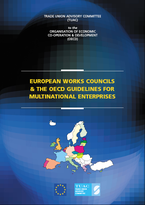
The Trade Union Advisory Committee (TUAC) to the Organisation for Economic Co-operation and Development (OECD) in Paris has presented a guide to conducting seminars, under the title “European works councils and the OECD guidelines for multinational enterprises". These guidelines are a component of global social responsibility of companies and often taken for concluding international framework agreements. The brochure provides basic knowledge of European works councils, international trade union structures and rules for multinational companies. Also included are charts that can be used for lectures. The guide is available in English, French, German and Czech.
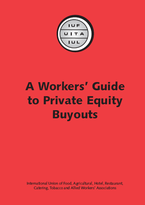
The International Union of Food Workers' Associations (IUF) in Geneva issued a brochure on financial investors in May 2007. It explains what private equity is, how it works and what dangers it entails for workers. It identifies possible strategies for negotiating with private equity funds and presents a series of case studies. The appendix provides a listing of the 50 largest private equity firms. The brochure is available in English, French, German, Swedish and Spanish.
Since February 2007 the third revised edition of a guide of Hans-Böckler-Foundation for the European company (SE) is available. It includes an overview of the methods of foundation, the involvement of employees and the conduct of negotiations on an agreement to participation. The full text of the Allianz SE agreement is printed. New in this brochure are now comments on the merger Directive, that was implemented in German law in December 2006. It regulates the cross-border mergers of companies. The brochure is only available in German.
This basic book of Prof. Däubler is now available in the 16th edition. Compared with previous editions it was enlarged at a point: the view beyond the boundaries of national events is not treated as a separate chapter, but is integrated into all subjects. Thus the author has finally abandoned the illusion that the globalization leaves the labour law untouched. The cost pressure stemming from low cost companies, the codes of conduct of American corporations, that 'penetrate' German subsidiaries, the threat of relocation – all are challenges, that can one not avoid. Including for European works councils the "guide for employees" is a recommended reference book. It is only available in German.
Wolfgang Däubler Das Arbeitsrecht 1 Leitfaden für Arbeitnehmer Reinbek 2006, 16. Auflage, 864 pages, ISBN 978-3-499-61966-3, € 16,90 → Further informationen → On-line order
|


|
12. Training and consultancy
network "euro-workscouncil.net":
further examples of
our work
|
|
Negotiations on EWC formation in a Chinese company
After a bidding war the state port company from Dubai (DP World) took over in March 2006 the traditional British company P&O (Peninsular and Oriental Steam Navigation) with its 29 container terminals. Thus, DP World has become the third largest port company in the world. In Europe, the company operates major terminals in the UK, Belgium (Antwerp), Romania (Constanta) and Germany (Germersheim).
P&O founded a European works council already in 2000, which is continued since May 2007 under the roof of DP World on an improved basis. It can now meet twice a year. With the support of the European Transport Workers' Federation (ETF), the "euro-workscouncil.net" training and consultancy network will provide a case study for the negotiations of the new EWC agreement. First results will be presented at a conference end of November 2007 in Livorno (Italy).
DP World had tried in 2006 to take over the Hamburg port company HHLA and was failed just as the German railway company Deutsche Bahn. In protest against the privatization plans several times the work in Hamburg harbour rested. Both DP World and the Hamburg HHLA be partially privatized on the stock exchange in November 2007.
Restructuring and financial investors
An extension of the strategic capacity of European works councils in the light of different traditions and cultures of industrial relations is the goal of a new coaching offer, which was developed by the training and consultancy network "euro-workscouncil.net" together with EWR Consulting in Frankfurt am Main, and now introduced to the public. Rudolf Reitter, the initiator of the concept, worked as an academic assistant at the European works council of the automotive supplier ZF Friedrichshafen for serveral years prior to his consulting activities and knows the problems in practice: “The early influence on site competition requires a consistent negotiating strategy, supported by business know-how". Three interrelated components will prepare the EWC members for this challenge.
A German market leader expands the range of seminars for European works councils
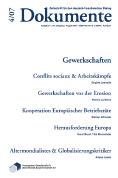
Dokumente, a magazine for the Franco-German dialogue, released a special issue on trade unions in August 2007. It contains several articles on labour disputes, membership development and transnational cooperation. Horst Mund and Kai Burmeister of IG Metall head office write on trade unions facing the challenge of Europe, the cooperation of European works councils is portrayed by Werner Altmeyer of the training and consultancy network "euro-workscouncil.net". At the same time the French sister magazine Documents also took up this issue, numerous articles have been published, therefore, in both languages.
Other journal articles
In July 2007 an article on French works council advisors in comparison to German trade union officers was published in the magazine Mitbestimmung and, in September 2007, a survey of current EWC court decisions in France was presented in the magazine Arbeitsrecht im Betrieb. All texts are in German: Other publications are available on our publications page.
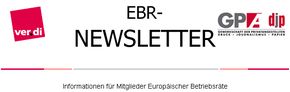
On 22nd October 2007, the fourth edition of the German-Austrian EWC newsletter of ver.di and GPA appeared, produced by the training and consultancy network "euro-workscouncil.net". It contains an interview with the head of the participation department of the ver.di federal office, Martin Lemcke, on the new Fresenius participation agreement, reports on the establishment of European works councils, including an interview with the newly elected EWC chairman of the Austrian energy company EVN, Paul Hofer, furthermore a presentation of the international activities of the ver.di department for financial services, background information about France and about recent court rulings as well as information on events and Internet resources. The newsletter is published only in German. |
 The
Hong Kong based automotive supplier Johnson Electric will establish a
European works council. Employee representatives from six countries
came together in Bremen from 16th to 19th September 2007 to discuss the
next steps to establish a special negotiating body (SNB). The event was
co-organized by the training and consultancy network
"euro-workscouncil.net". European central management in Switzerland
will support the EWC foundation constructively. Since 1992 the company
is represented in Germany and since 2003 in Italy, since then numerous
factories in Western and Eastern Europe were purchased. Johnson
Electric may be the first Chinese company with an EWC.
The
Hong Kong based automotive supplier Johnson Electric will establish a
European works council. Employee representatives from six countries
came together in Bremen from 16th to 19th September 2007 to discuss the
next steps to establish a special negotiating body (SNB). The event was
co-organized by the training and consultancy network
"euro-workscouncil.net". European central management in Switzerland
will support the EWC foundation constructively. Since 1992 the company
is represented in Germany and since 2003 in Italy, since then numerous
factories in Western and Eastern Europe were purchased. Johnson
Electric may be the first Chinese company with an EWC.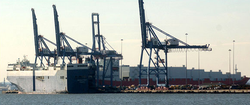


|
13.
Current seminars
|
|
Registration is possible for the following seminars and workshops co-made by us:
Establishment of European works councils in the port industry 18 -- 24-11-2007 in Livorno (Italy)
Works council activities in Europe, the European works council (EWC)
Europe for trade union officers of IG Metall Institutions -- Policies -- European works councils 16 -- 18-04-2008 in Bad Orb 13 -- 15-10-2008 in Bad Orb
In-house events Please find a survey of possible subjects of in-house events here: → Topics for in-house training → Topics for in-house lectures
|
|
14. Imprint
|
EWC
News is published by: Training
and consultancy network "euro-betriebsrat.de" GbR Von-der-Tann-Straße
4, D-20259 Hamburg www.euro-workscouncil.net (English) www.euro-ce.org
(French) Authors
collaborating on this
issue: Werner Altmeyer, Carmen Bauer, Kathleen
Kollewe, Bernhard Stelzl, Reingard Zimmer Distributor
of the German
version: 9,050 readers Distributor of
the English version: 932 readers Distributor of
the French version: 614 readers Newsletter
archive: www.ewc-news.com
We are always pleased to
receive comments and suggestions in relation to this newsletter as well
as reports on your EWC activities. Please write us at: info@euro-workscouncil.net
www.euro-betriebsrat.de (German)