 |
 Welcome to issue no. 4 / 2008 of EWC News. 23rd December 2008
|

|
The training and consultancy network
"euro-workscouncil.net"
EWC
News appears four times a year.
You can find past issues in the newsletter archives.
|


|
1.
New EWC
Directive can become effective
|
|
Only British government refused its consent
26 governments from Bulgaria to Ireland from Portugal to Estonia accepted the compromise, only the British Labour government did not want to help to carry the bill. The U.S. position is fundamentally more pragmatic against this. The adoption of the Directive is welcomed particularly by the American Chamber of Commerce in Germany because of planning safety, so that transparency is guaranteed in the European branch offices of U.S. companies.
A common recommendation of the trade unions and employers' federations of August 29th, 2008 had already paved the way to the new Directive (see report in EWC News 3/2008). On November 17th, 2008, the Committee on Employment and Social Affairs of the European Parliament then decided with the voices of Social Democrats, Greens, the Left and parts of its conservative members on several changes on the bill which meets trade union demands. On December 4th, 2008 the European Economic and Social Committee (EESC), a consulting committee from representatives of unions, employers and other groups, demanded an improved EWC Directive. Already in September 2006 EESC had voiced in favour of it. Trialogue conversations brought about the breakthrough
There were informal conversations behind the scenes between European Commission, European Parliament and Council of Ministers at the beginning of December 2008. This so-called trialogue led to a compromise to which the unions too finally agreed. The new EWC Directive replaces the text from the year 1994 and has to be converted within two years into the legal system of all countries of the European single market. All EU countries as well as Norway, Iceland and Liechtenstein are included. Future EU countries like Croatia or Turkey will use the Directive as of the day of their joining.
Hamburg specialist conference to the new EWC Directive: What comes towards us there?
The training and consultancy network " euro-workscouncil.net " offers the opportunity on January 26th, 2009 on an EWC specialist conference in Hamburg to discuss the new legal situation with experts from Brussels as well as from German science and practice in detail. Further specialist conferences to the new EWC Directive
Rom, Villa Borghese, May 7/8th, 2009 (simultaneous interpretation German -- Italian available, English on request)
Liège in summer 2009 (an exact appointment will soon be fixed, simultaneous interpretation German -- French available, English on request)
German works council members can take part according to § 37, para. 6, Works Constitution Act. Non-binding reservations are already possible over the contact form. We then inform about the programme and the details on the participation on time.
|
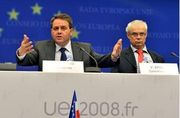
 The Council of Ministers agreed on the new
Directive on European works councils on December 17th, 2008 in
Brussels. On the day before the European Parliament had agreed in a
plenary session with a large majority. The French Minister of Labour
Xavier Bertrand (on the photo on the left, together with EU social
Commissioner Vladimír Špidla) wanted to complete
the procedure politically under the French Presidency in 2008. Since
linguistic problems with the translation of the Directive could not be
processed on time, the formal decision making will take place in a
meeting of the Council of Ministers in January 2009.
The Council of Ministers agreed on the new
Directive on European works councils on December 17th, 2008 in
Brussels. On the day before the European Parliament had agreed in a
plenary session with a large majority. The French Minister of Labour
Xavier Bertrand (on the photo on the left, together with EU social
Commissioner Vladimír Špidla) wanted to complete
the procedure politically under the French Presidency in 2008. Since
linguistic problems with the translation of the Directive could not be
processed on time, the formal decision making will take place in a
meeting of the Council of Ministers in January 2009.
|
2.
Which
changes brings the new Directive?
|
|
Strengthening of the
EWC only possible by negotiation
Information
and consultation is defined better
The role of the steering committee is strengthened For the first time it gets the right to independent meetings and is increased personally.
Closer cooperation with national works councils Since the European works council is only responsible for transnational issues, its work must be better linked to the national works councils. This also includes the duty of EWC members to report to the staff of its country of origin.
Right for training For the first time a legal right is confirmed legally on training measures.
Renegotioation of EWC agreements at mergers In future there will be the right to terminate and renegotiate older EWC agreements at mergers and extensive restructurings.
Effective and deterrent sanctions
The wording that all countries must provide " effective, dissuasive and proportionate sanctions " in their respective EWC laws if the rights of the European works council are violated is part of the most important points. This can be an injunctive relief as it was already succeeded in the case of the European works council of Gaz de France in front of the court (see report in EWC News 1/2008). A powerful European works council does not come along as a "present from Brussels" but only by courageous workers' representatives, who if necessary call in their rights also in front of the court. Remarkable: In Germany there isn't any single verdict, which relates to the rights of an EWC. So it remains much to do for works councils. Special problems for British European works councils During the revision process British government had benevolently accompanied the employers' lobby campaign against the new Directive (see report in EWC News 3/2008), although Labour members of the European Parliament supported the trade unions' position. It is up to the national parliaments now as they fill the new regulations with lives. While there is a good chance in many old EU countries (France, Benelux, Germany, Scandinavia) for clear decisions of the legislator, an implementation in conformity with the EU is expected particularly in the United Kingdom with tension. One will have to watch very considerably also in some Eastern European countries how the parliaments handle this topic. Shall the violation of EWC rights remain a peccadillo or draw hard conclusions in front of the court? It will be decisive whether effective and deterrent sanctions of the workers' representatives can be sued for also in front of British or Polish courts. |
 Relocations
as in the case of Nokia (see
Relocations
as in the case of Nokia (see 
|
3. New
collective bargaining law in France
|
|
Special role of the five trade union confederations to be removed
Any trade union which has got the status of representativeness from the government can conclude in-plant collective agreements till now even if it has only one single member in the company and doesn't get support in works council elections. In future the representativeness of an organisation will be decided by works council elections -- and so by the workforce itself. Trade unions, which gain less than 10% of the electoral vote in the company can conclude no more in-plant agreements and cannot appoint any trade union delegates. For an in-plant agreement to be valid the signing trade unions must unite at least 30% of the electoral vote. The number of members is not important.
For valid regional or industry-wide collective agreements in future 8% of the votes in elections to all works councils of the area are required. In order to measure the representativeness French employers must therefore notify the Department of Employment of the results on a special form within two weeks after completion of the works council elections.
Similar regulations are already valid in Spain for many years and led to a constructive cooperation of Spanish trade unions in the bargaining policy. In Spain all collective agreements are actually signed by CC.OO. and UGT together. While trade unions are bundling their strength in many parts of Europe by mergers, French organisations split themselves always further up and even fight themselves. It is expected this trend is turning now, because small unions lose their prerogatives with the new law.
No changes to the freedom to strike
The right to strike remains an individual human right also in future, which cannot be controlled by any trade union and cannot be limited by any employer. In the opinion of French courts, three participants are enough to carry out a legal strike. France knows neither strike ballots nor strike pay. Employers must therefore prove a high sensibility to guarantee industrial peace. The following contributions light the role of shop floor representation and the trade union landscape (only available in German): |
 A reform of the collective bargaining system
which ends the consensus of the post-war period about the
representativeness of trade unions becomes effective in France on
January 1st, 2009. It orientates itself at the pragmatic rules in
Spain. Till now it was usual in France, that the status of the trade
union representativeness was awarded by the government. This was
carried out last in 1966 as the CFDT as a new confederation joined. The
origins of this procedure are located in the Cold War when it was all
about to break the supremacy of the communist CGT. The Sarkozy
government has terminated this chapter of the French labour legislation
with the law of August 20th, 2008.
A reform of the collective bargaining system
which ends the consensus of the post-war period about the
representativeness of trade unions becomes effective in France on
January 1st, 2009. It orientates itself at the pragmatic rules in
Spain. Till now it was usual in France, that the status of the trade
union representativeness was awarded by the government. This was
carried out last in 1966 as the CFDT as a new confederation joined. The
origins of this procedure are located in the Cold War when it was all
about to break the supremacy of the communist CGT. The Sarkozy
government has terminated this chapter of the French labour legislation
with the law of August 20th, 2008.|
4. Mergers keep
the EWC busy
|
|
Staff cuts after merger of tobacco groups
At present, there are two European works councils in the group. Imperial Tobacco had founded an EWC according to British law in 1996 and Altadis in 2002 an EWC according to Spanish law. Both now shall be brought together to one single council. In the opinion of the trade unions it is required that the EWC of Imperial Tobacco takes part in all EWC meetings of the steering committee of Altadis as of now to ensure a coordinated strategy.
Workers'
representatives of the two IT firms Hewlett-Packard (HP) and Electronic
Data System (EDS) met in Brussels on October 15th, 2008 to analyse the
joined EWC meeting of September 25th, 2008 (see report in
EWC News 3/2008). HP had taken over the competitor EDS in
August 2008. Workers' representatives criticize that central management
violates the EWC Directive because it confronts the two European works
councils with perfected facts and doesn't carry out any consultation.
The aim of consultation for the two works councils is to take on
negotiations about the restructuring.
Representatives of the European works councils of BNP Paribas and Fortis met in Paris for the first time on October 20th, 2008 to discuss the forthcoming merger. The largest French commercial bank BNP Paribas wants to take on all activities of the Belgian Luxembourg finance group of Fortis outside the Netherlands as a result of the financial crisis. The Dutch part of Fortis had been nationalized on October 3rd, 2008.
From an economic point of view the merger would make sense as both banks complete each other geographically, so the workers' representatives. They demanded however the development of a social chapter in the context of the merger contract. The European works council of Fortis which had been founded according to Belgian law in 1996 was officially informed about the merger in a plenary session on November 20th, 2008. Presumably it will soon be combined with the EWC of BNP Paribas also founded in 1996 according to French law. Shortly before Christmas the merger plan led to a governmental crisis in Belgium. The following documents are available only in French: |
 European-wide
action day at HP and EDS
European-wide
action day at HP and EDS 
|
5.
Foundation
of European works councils
|
|
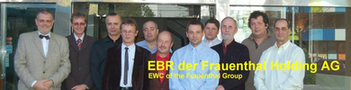
New EWC of Frauenthal Holding with its own Internet Blog
The EWC already has an internet page of its own with a Blog. All information is available in seven languages, there is also a portrait of all EWC members and the steering committee. The training and consultancy network " euro-workscouncil.net " was prior to the EWC foundation involved in the drafting of corner points (see report in EWC News 4/2007).
The U.S. company Timken has established an European works council according to British law, the "Timken European Communication Council". The negotiations were completed on May 30th, 2008 and on September 1st, 2008 the EWC agreement signed. In the European comparison however it includes regulations only below average.
The EWC is a mixed committee which meets once a year and to which representatives of the management also belong. The employees' side consists of twelve delegates from 9 countries among this two each from France, Poland and Romania. The steering committee consists of two employers and two workers' representatives. There are strict rules on confidentiality, only one single training day is scheduled every four years. A clause provides that the agreement is checked as soon as the new EWC Directive has been transposed into British law.
IT service provider in the tourism sector founds EWC
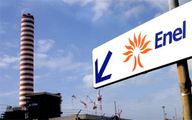
Energy group sets standards for EWC agreements The European works council of Enel consists of twenty members and meets twice every year. It chooses a steering committee from five members who meet four times per annum. The definition of information and consultation already orientates itself at the new EWC Directive, four training days are scheduled per annum. With that Enel has one of the best EWC agreements according to Italian law and can compete with the standard of the bank group of UniCredit (see report in EWC News 1/2007). Texts of numerous EWC agreements are available on a download page.
|


|
6. Europe-wide
EWC contract policy
|


|
Norwegian companies take on social responsibility
The central management of the Norwegian conglomerate Aker signed an international framework agreement with the International Metalworkers' Federation (IMF) in Oslo on October 28th, 2008. The worldwide compliance with social minimum standards and the development of good work relations is aim in all parts of the group which is working in the offshore, fishing, shipyard and construction area in 35 countries with 27,000 employees. Already since 1996 an European works council exists at Aker.
Trade union rights in the Freudenberg consortium
On November 3rd, 2008 central management of the German chemical enterprise Freudenberg signed an amendment to the framework agreement from the year 2000 with the International Federation of Chemical Workers' Unions (ICEM). With this the company respects the decision of all employees to join a trade union of one’s choice. ICEM will worldwide support a constructive dialog between workers and management in all branch offices. A meeting of the management with trade union representatives in Canada and the USA had gone ahead in Pittsburgh, Pennsylvania, on October 1st, 2008. The European works council of Freudenberg founded in 1996 is engaged strongly in the protection of health (see report in EWC News 4/2007).
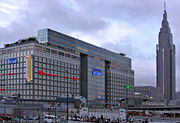
A Japanese company signed for the first time an international framework agreement on November 11th, 2008. The central management of the department store chain Takashimaya (on the photo the branch office in Tokyo) commits itself to a worldwide social dialog with trade unions. In Europe the company has till now only one single branch office in the city centre of Paris and therefore doesn't fall under the EWC Directive yet.
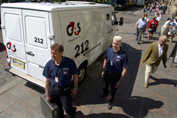
For the first time agreement in a British service industry
|

|
8. The
world of SE works councils
|
|
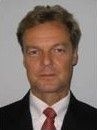
On December 3rd, 2008 at its meeting in Berlin, the special negotiation body (SNB) of the adhesive manufacturer tesa voted for the acceptance of a SE agreement which had been negotiated under a considerable pressure of time within the weeks before (see report in EWC News 2/2008). At the transformation of a company into a European Company (SE), the SNB has only six months to settle all issues, which is different as compared to the foundation of an European works council. The tesa agreement is regarded as one of the best, which has till now been negotiated for a German company with only just under 2,000 employees and thus with a third participation in the supervisory board. Frank Ganschow (photo), chairman of the SNB, explained the course of the negotiations and the most important points of the new agreement in an interview with EWC News. Workers' representatives of tesa were supported by Prof Dr Ulrich Zachert and Dr Werner Altmeyer of the training and consultancy network "euro-workscouncil.net" during their negotiations. But experts cannot prevent what the legislator has failed to see: Companies of the range of tesa can "freeze" the participation in the supervisory board namely at the time of the SE transformation. This problem was now recognized by a group of experts engaged by the European Commission and they suggest a customization of the SE Directive which lies ahead in the year 2009 (see report in EWC News 3/2008).
New SE foundations without employees in the supervisory board
Since December 2nd, 2008 the solar equipment manufacturer Solon from Berlin also has registered as SE. The agreement signed at the beginning of November 2008 doesn't provide any participation for the 850 employees in the supervisory board. There are European subsidiaries in Austria, Italy and Switzerland.
On 8 October 2008, the film manufacturer RKW (Rheinische Kunststoffwerke) was registered as an SE, although no agreement on participation was concluded. The company, based in Frankenthal (Rhineland-Palatinate), is the first case in Europe in which the negotiations failed. For the 2,700 employees in eight countries, the statutory standard rules on the SE works council and a third participation on the supervisory board apply.
Volkswagen gains chairmanship in the SE works council of Porsche
On December 15th, 2008, the SE works council of Porsche Automobil Holding SE constituted itself on the basis of a SE participation agreement in which the works councils of Volkswagen had not been involved. The SE works council consists of 40 members: the 20 representatives of Porsche, amongst this 15 from Germany, represent the 12,000 Porsche employees. 20 representatives of Volkswagens, amongst this seven from Germany, represent the 360,000 VW employees. This numerical ratio had been regarded as undemocratic by the Volkswagen works councils, which led to a public exchange of blows and several legal proceedings (see report in EWC News 3/2007).
|

 SE negotiations failed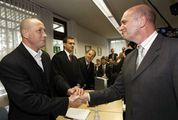
|
9. Newsletter
for workers'
representatives
|
|
The EWC bulletin of UniCredit
The EWC of the furniture house Ikea met in Copenhagen on October 28th, 2008. It is part of the particularly active councils in Scandinavia and has formed several committees. A main emphasis of its activity is health and safety at work. It presents the current developments in a newsletter. The third version has been published in November 2008. The " Ikea European Consultative Council " was founded according to Danish law in 1999.
Another version of the German Austrian EWC newsletter of ver.di and GPA trade unions has been published on October 29th, 2008. Main emphasis of this version is the political process for the revision of the EWC Directive. Broader topics are: the financial crisis, the establishment of European works councils, a background report on Romania, literature tips and event notes. The EWC newsletter is co-formed by the training and consultancy network " euro-workscouncil.net " and is only available in German.
At the end of November 2008 the current newsletter on Corporate Governance of the European trade union institute has been published on the web page "Worker-Participation.eu". Since July 2006 it has informed about questions of the employee participation in the administrative and supervisory boards of companies and the latest European (law-) developments. As a central theme the current version picks the legal form of the European Private Company, which in addition to the European Company (SE) shall make possible a kind of European plc. Another topic is the EU merger Directive. |
 The
European works council of the Italian bank UniCredit founded in 2007
(see
The
European works council of the Italian bank UniCredit founded in 2007
(see 
 Newsletter
to the Corporate Governance
Newsletter
to the Corporate Governance|
The European works council in Romania and Bulgaria
Worldwide alliance of Coca-Cola employees
The global trade union alliance of Coca-Cola employees has set up a web page of its own delivering current reports from the group in 15 languages. The workers' representatives of the drink group met for the second world conference in Germany in May 2008 (see report in EWC News 3/2008). Observation of finance investors
The location Germany under globalisation pressure
We have arranged numerous further interesting links in a link collection.
|



 The project export-IT examines changes of
companies in the service sector in the worldwide division of labour through
information and communication techniques. With support of German trade
unions ver.di and IG Metall "best pracice" examples shall be worked out
also for the workers' representation in this line of business.
The project export-IT examines changes of
companies in the service sector in the worldwide division of labour through
information and communication techniques. With support of German trade
unions ver.di and IG Metall "best pracice" examples shall be worked out
also for the workers' representation in this line of business.
|
11. New
publications
|
|
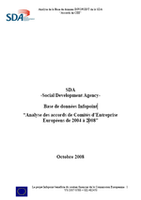
The Social Development Agency (SDA) in Brussels presented a new evaluation from 102 EWC agreements of its database in October 2008 which examines qualitative and quantitative developments in the time period of the last four years. From the 102 EWC agreements which were signed since 2004, 19 are from Germany and France, 16 from the UK and ten from Belgium each. Italy recorded the strongest increase with eight new EWC agreements. The country has 39 European works councils now, however is still located in the delay. Although training measures aren't regulated obligatorily in the old EWC Directive, this was confirmed Europe-wide in 76% of all cases in the EWC agreement since 2004.
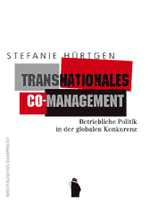
How can the staff of international large companies work out a common action perspective? Dr Stefanie Hürtgen, employee at the institute for social research of University of Frankfurt am Main, follows this question in her PhD thesis, which was published in November 2008. It documents the work of French workers' representatives of the trade unions CGT, CFDT and FO, of German works councils of IG Metall in the west and east as well as Polish EWC members of the trade unions Solidarność and OPZZ. The interviews don't only show how operational problems are handled concretely in single countries, but also examines the respective integration into the European works council. The book is only available in German.
Stefanie Hürtgen Transnationales Co-Management Betriebliche Politik in der globalen Konkurrenz Münster 2008, 313 pages, € 29,90
Current comparison of industrial relations in Western and Eastern Europe
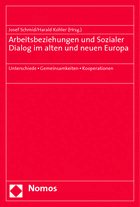
Josef Schmid/Harald Kohler (ed.) Arbeitsbeziehungen und Sozialer Dialog im alten und neuen Europa Unterschiede - Gemeinsamkeiten - Kooperationen Baden-Baden 2008, 331 pages, € 22,-
Effectively presenting - in English?
Matt Beadle Präsentieren - wirkungsvoll und strukturiert Berlin 2008, 192 pages, € 16,95
We have compiled additional technical literature on a special page.
|

|
12. Training
and consultancy network " euro-workscouncil.net ":
Examples of our work
|
|
A workshop in the context of the project IN.CON.PAR_able took place in Hamburg in the DGB training centre on October 14th and 15th, 2008. The aim of the project, which was initiated by the Spanish trade union confederation CC.OO. is the improvement of cooperation in European works councils by coordination of the activities and the communication among each other. Dr Reingard Zimmer of the training and consultancy network " euro-workscouncil.net " participated in the preparations for and execution of the workshop, which similarly takes place also in Spain, Portugal, Italy and Bulgaria. A project report in German is in preparation.
ver.di-federal office: survey of EWC work
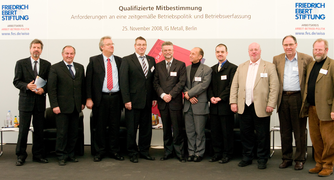
On November 25th, 2008 the study group Labour – Company – Politics of the Friedrich-Ebert foundation conducted a meeting on works constitution in Berlin. About 170 works council members, scientists and politicians discussed a reform agenda to participation with a number of experts (photo). Werner Altmeyer of the "euro-workscouncil.net" explained the European level. The following documents are only available in German:
EWC project at Lüneburg University
Contributions in professional journals
In November 2008 the magazine der betriebsrat (the works council) published a country report on Spanish works’ constitution of Dr Werner Altmeyer and Prof Dr Holm-Detlev Köhler. The contribution also contains an interview with a German EWC member of the Spanish big bank Santander. Dr Werner Altmeyer examined the legislation process and the possible consequences of the new EWC Directive in a contribution for the journal Personalführung (personnel management) in December 2008. Both articles are only available in German. You find additional English language publications at our publication page.
|
 The
European works council optimizes its working conditions
The
European works council optimizes its working conditions

|
13. Details
of seminars planned
|
|
Registrations are possible for the following seminars and workshops co-made by us (in German):
The new EWC Directive -- What comes towards us there? Specialist conferences for European works councils 26-1-2009 in Hamburg 07. -- 8-5-2009 in Rome Summer 2009 in Liège (an exact appointment is still to be fixed)
Institutions, politics, European works councils 25. -- 27-3-2009 in Bad Orb 14. -- 16-10-2009 in Bad Orb
Seminars of the institute for further education of works councils (ifb)
Basic seminar: The way to the European works council 31.03 -- 3-4-2009 in Cologne 20.10 -- 23-10-2009 in Würzburg
Advanced seminar: Practice knowledge, EWC special 02. -- 5-6-2009 in Cologne 17. -- 20-11-2009 in Nuremberg
Workshops of ver.di-federal office
In the year 2004 an cross-sectoral workshop of the ver.di federal office for European works councils took place for the first time. In view of the new EWC Directive there are two appointments in 2009:
The revision of the EWC Directive
Basis knowledge and practice of the EWC work 02. -- 4-9-2009 in Berlin
As part of a further education series for trade union officers and works council members the academy of Ruhr university Bochum offers the following:
Training for Europe, the European works council Concepts, distribution, practice experiences, development prospects 30. -- 31-10-2009 in Bochum
In-house events Please find a survey of possible subjects of in-house events here: |
 Europe for trade union officers
of IG Metall
Europe for trade union officers
of IG Metall 
 17. -- 19-6-2009 in Berlin
 Further education at
Ruhr university
Further education at
Ruhr university|
14. Imprint
|
EWC
News is published by: Training
and consultancy
network "euro-betriebsrat.de" GbR Von-der-Tann-Straße
4, D-20259 Hamburg www.euro-workscouncil.net (English) www.euro-ce.org
(French) Authors
collaborating on this issue: Werner Altmeyer,
Carmen Bauer, Ulrich Zachert,
Reingard Zimmer Distributor
of the German
version: 11,508 readers Distributor of
the English version: 1,378 readers Distributor of
the French version: 1.119 readers Newsletter
archive: www.ewc-news.com
We
are always pleased to
receive comments and suggestions in relation to this newsletter as well
as reports on your EWC activities. Please write us at: info@euro-workscouncil.net
www.euro-betriebsrat.de (German)